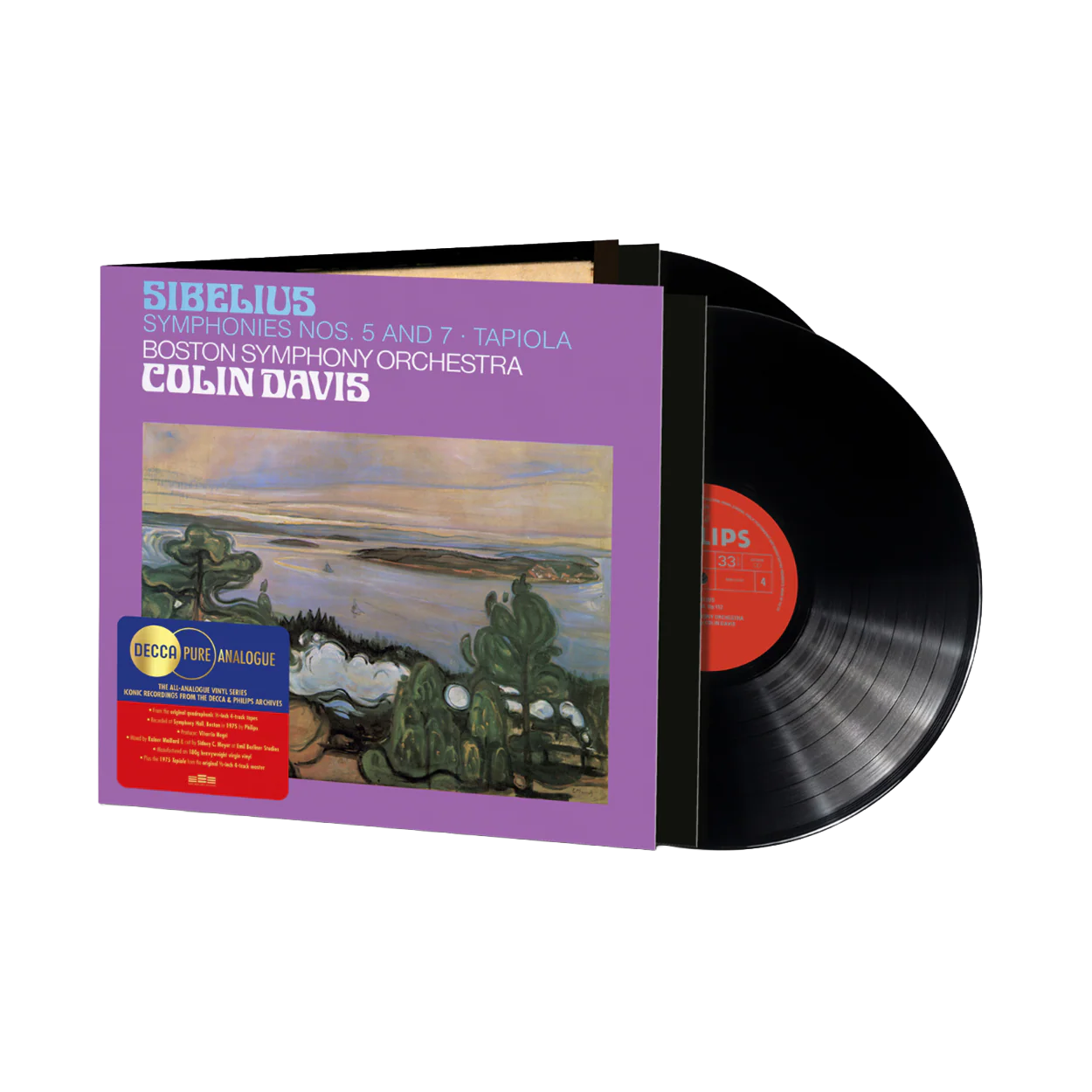
Sibelius: Symphonies 5 & 7 - Vinyl 2LP
MIXED AND MASTERED FROM THE ORIGINAL PHILIPS QUADRAPHONIC TAPES
Pressed at Pallas on 180g virgin vinyl, these limited-edition deluxe gatefold releases will feature: the original artwork and liner notes; archival photos and facsimiles of original recording session sheets. Each individual release includes bespoke notes detailing the history of the recording, the technical background and the mastering process.
Colin Davis’ first Sibelius cycle with the Boston Symphony Orchestra was released in 1977, one of the world’s most august record clubs — the Carnegie Hall Selection Committee — deemed it definitive: “the leading Sibelius conductor of our time joining forces with what may well be the finest Sibelius orchestra in the world.” When Symphonies 5 and 7 were recorded to four-track in January 1975, Symphony Hall Boston was no stranger to experiments in quadraphonic recording ever since Deutsche Grammophon became the orchestra’s exclusive record label in 1970; however by the mid-1970s, quadraphony was all but abandoned and this album was never released as a quad LP.
For this release Rainer Maillard at Emil Berliner Studios has used the original, edited four-track quadraphonic master tape to make a new stereo mix sent directly to the cutter head. This preserves a pure analogue path throughout. The Philips engineers of the 1970s would similarly have mixed the four front and rear channels before cutting but this downmix would have resulted in a two-track stereo copy for mastering, whereas here the lacquer is cut directly from a ‘live’ mix into stereo from the four Quad channels. Sonic results have been further enhanced by distributing the recording across three sides instead of the original double-sided LP. This has also enabled us to include Davis’ December 1975 recording of Sibelius’ last major orchestral work, Tapiola, on the fourth side.
“No one listening to Colin Davis’s cycle of Sibelius symphonies will be left in any doubt that here is a born Sibelian and that these recordings are a very considerable achievement.” — Gramophone, 1977
Jean Sibelius (1865–1957)
Side A: Symphony No. 5 in E-flat, Op. 82 – I. Tempo molto moderato – Largamente – Allegro moderato
Side B: Symphony No. 5 (cont.) – II. Andante mosso, quasi allegretto / III. Allegro molto
Side C: Symphony No. 7 in C, Op. 105
Side D: Tapiola, Op. 112
Original: $100.04
-65%$100.04
$35.01Product Information
Product Information
Shipping & Returns
Shipping & Returns
Description
MIXED AND MASTERED FROM THE ORIGINAL PHILIPS QUADRAPHONIC TAPES
Pressed at Pallas on 180g virgin vinyl, these limited-edition deluxe gatefold releases will feature: the original artwork and liner notes; archival photos and facsimiles of original recording session sheets. Each individual release includes bespoke notes detailing the history of the recording, the technical background and the mastering process.
Colin Davis’ first Sibelius cycle with the Boston Symphony Orchestra was released in 1977, one of the world’s most august record clubs — the Carnegie Hall Selection Committee — deemed it definitive: “the leading Sibelius conductor of our time joining forces with what may well be the finest Sibelius orchestra in the world.” When Symphonies 5 and 7 were recorded to four-track in January 1975, Symphony Hall Boston was no stranger to experiments in quadraphonic recording ever since Deutsche Grammophon became the orchestra’s exclusive record label in 1970; however by the mid-1970s, quadraphony was all but abandoned and this album was never released as a quad LP.
For this release Rainer Maillard at Emil Berliner Studios has used the original, edited four-track quadraphonic master tape to make a new stereo mix sent directly to the cutter head. This preserves a pure analogue path throughout. The Philips engineers of the 1970s would similarly have mixed the four front and rear channels before cutting but this downmix would have resulted in a two-track stereo copy for mastering, whereas here the lacquer is cut directly from a ‘live’ mix into stereo from the four Quad channels. Sonic results have been further enhanced by distributing the recording across three sides instead of the original double-sided LP. This has also enabled us to include Davis’ December 1975 recording of Sibelius’ last major orchestral work, Tapiola, on the fourth side.
“No one listening to Colin Davis’s cycle of Sibelius symphonies will be left in any doubt that here is a born Sibelian and that these recordings are a very considerable achievement.” — Gramophone, 1977
Jean Sibelius (1865–1957)
Side A: Symphony No. 5 in E-flat, Op. 82 – I. Tempo molto moderato – Largamente – Allegro moderato
Side B: Symphony No. 5 (cont.) – II. Andante mosso, quasi allegretto / III. Allegro molto
Side C: Symphony No. 7 in C, Op. 105
Side D: Tapiola, Op. 112